
Model the shop, not a generic funnel
The schema connects customers to multiple vehicles, jobs, parts, assignments, appointments, invoices, estimates, and service reminders.
Case study · Custom CRM · Production client system
JNC Suite is a custom CRM and operations platform Jiss Tech built for an independent auto shop. It connects the customer, vehicle, job, billing, appointment, messaging, and reporting workflows the team uses in daily production. The owner reports customer retention up 89% since adopting it; that figure has not been independently audited by Jiss Tech.
Business / product problem
An independent repair shop is a deceptively complex operation. One customer owns three vehicles. A job carries parts, labor, and two staff assignments. A quote and the eventual invoice need to preserve the approved work. Appointments, reminders, and promotions all need to reflect real service history — not a marketing list.
Off-the-shelf tools model pieces of that. The gaps get filled with paper, spreadsheets, and memory — which works until the person holding it all in their head takes a day off. The brief for JNC Suite was simple to say and demanding to build: run the entire shop from one system.
Product overview
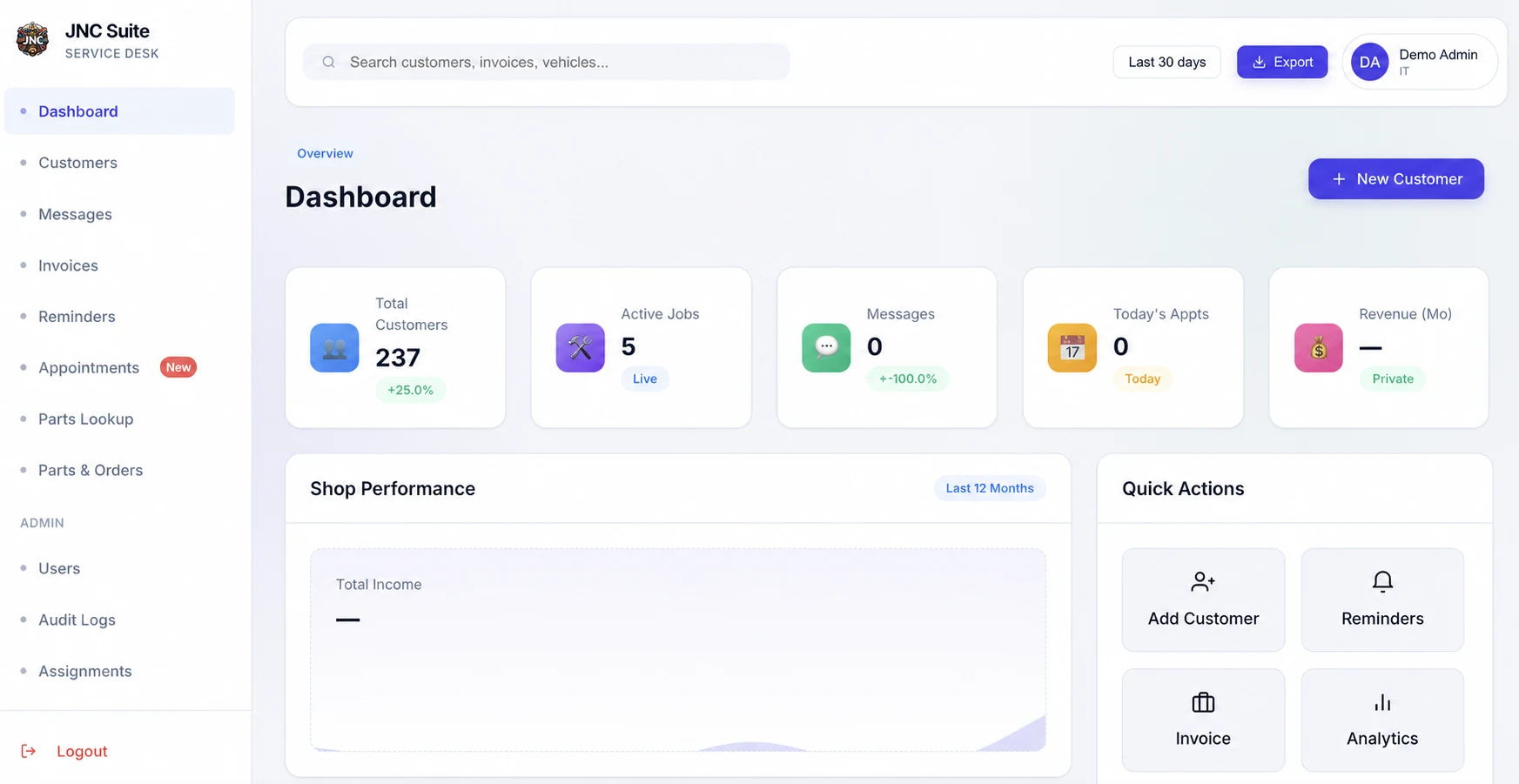
Each workflow reads and writes the same records, so the dashboard, the invoice, and the reminder text always agree about the customer, the vehicle, and the work.
Multiple vehicles per customer, primary-vehicle selection, service status, and full history in one record.
Itemized estimates and invoices with tax calculation and tokenized PDF links customers can open on their phones.
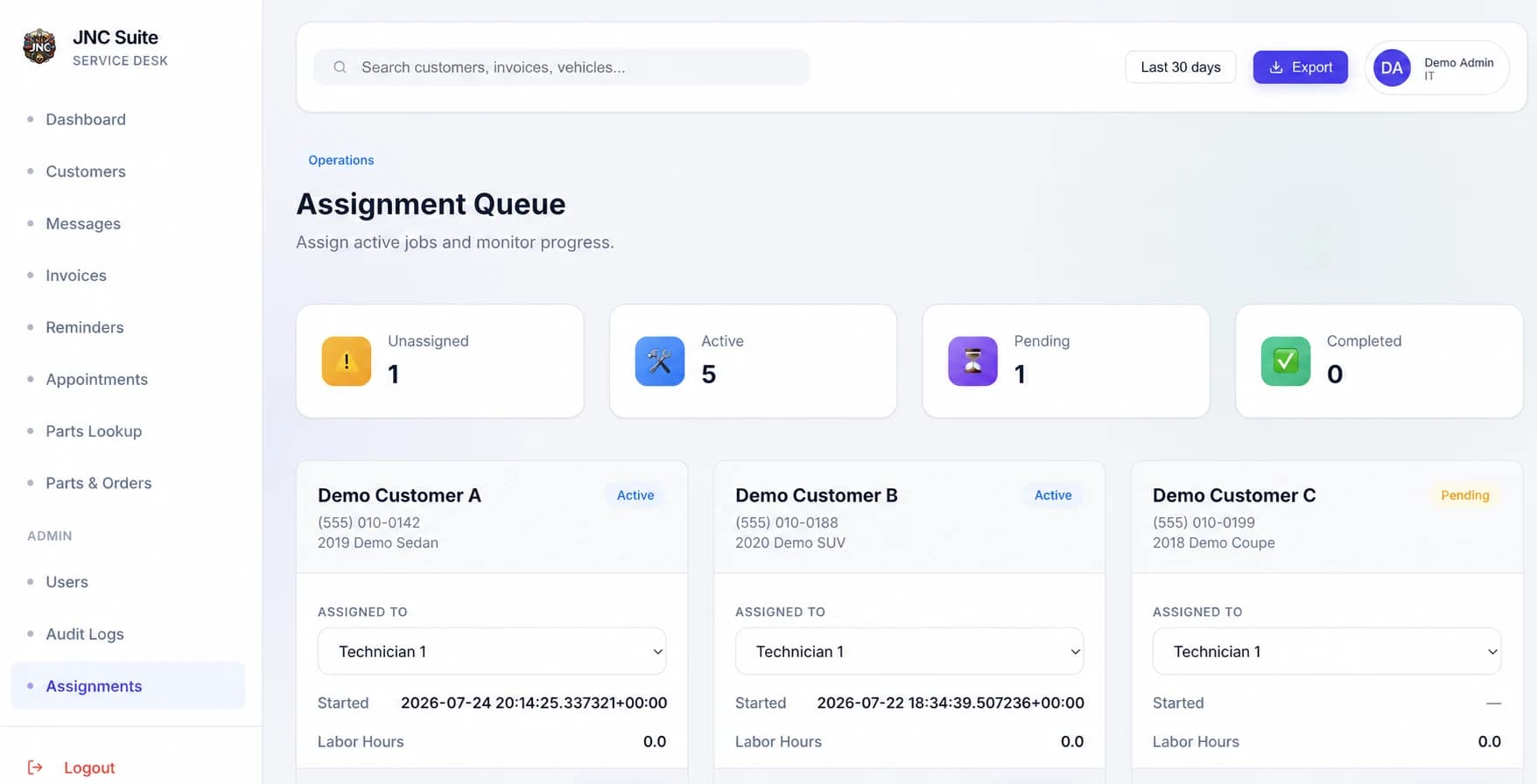
Work moves from pending to active to completed with staff assignments and automatic labor tracking.
Catalog items, on-hand quantities, orders, job links, and used-parts cost.
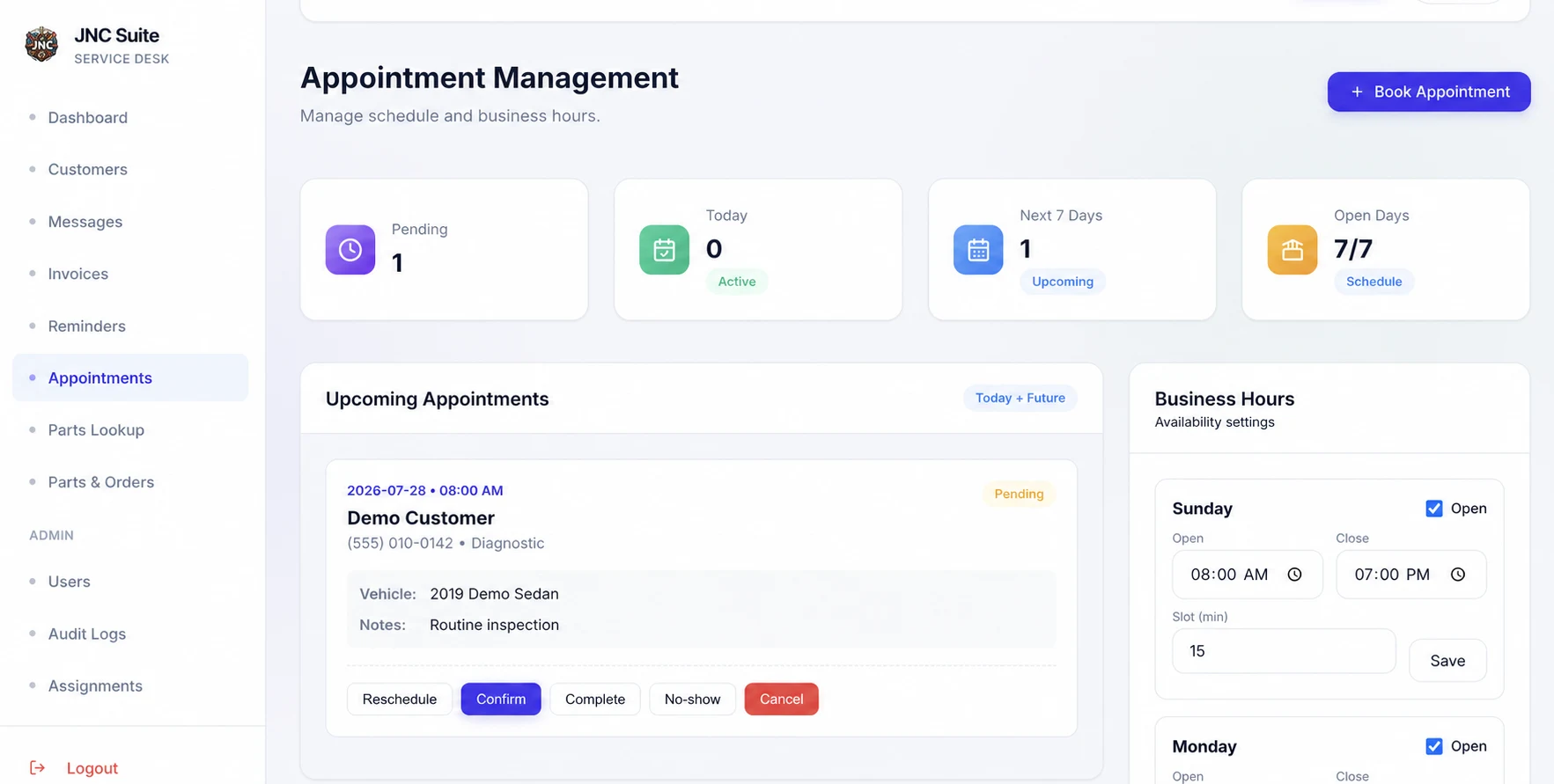
Upcoming and past appointments, confirmations, cancellations, and business hours.
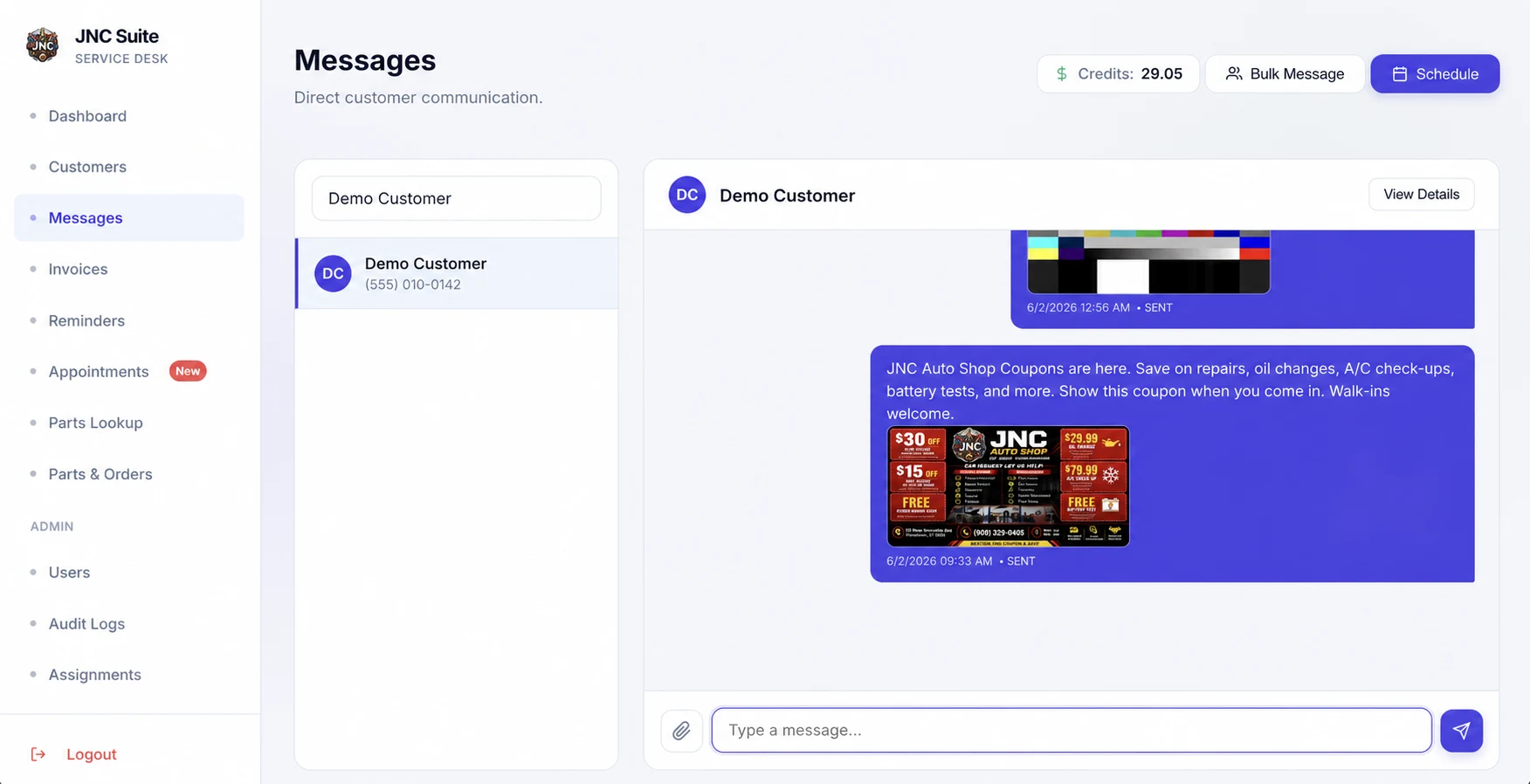
Automated service reminders and promotional SMS sent from real customer and vehicle records.
Revenue, parts spend, throughput, labor hours, cycle time, and active work at a glance.
Owner, employee, and administrator roles with granular permissions and recorded actions.
Inside the platform
Portfolio screens use demo data; customer information has been removed.
Verified architecture
JNC Suite keeps shop workflows in a Python/Flask application organized by blueprints. Staff use server-rendered pages, customer-facing invoice and estimate links return generated PDFs, Twilio carries messaging, and APScheduler runs reminder work. The production code supports PostgreSQL with a SQLite fallback; the active production database mode is not stated publicly.
Technology
Every technology below is tied to the audited project source—not to a company-wide capability list.
Constraints
Solution
Engineering challenges
The schema connects customers to multiple vehicles, jobs, parts, assignments, appointments, invoices, estimates, and service reminders.
Job transitions record start and completion timestamps, allowing labor hours, throughput, cycle time, and staff activity to be calculated.
Tokenized document links and Twilio messages make invoices, estimates, reminders, and promotions available from the customer's phone.
Integrations
Reliability & security
Outcome
JNC Suite is used in production as the shop's connected CRM and operations system. The implementation replaces disconnected records with one workflow for customers, vehicles, jobs, appointments, parts, billing, messages, reminders, permissions, and operational reporting.
The owner reports customer retention up 89% since adopting JNC Suite. That figure is presented as owner-reported and has not been independently audited by Jiss Tech.
Lessons learned
Related Jiss Tech services
Reported operational outcome
The highest-impact feature isn't a screen — it's what happens when nobody is looking. Service reminders and promotional texts send automatically from real customer and vehicle records. Invoices went paperless, opened by customers right on their phones. Estimates that took a clipboard and a callback now take minutes.
The owner reports customer retention up 89% since adopting the system and attributes the improvement to automated reminders and promotional texts. Jiss Tech has not independently audited the figure or established a single causal factor.
Reported by the owner
+89%
customer retention since adopting JNC Suite. Owner-reported and not independently audited by Jiss Tech.
What this proves
JNC Suite works because it models the shop's reality — customers with multiple vehicles, jobs with parts and labor, staff with different permissions — instead of asking the shop to conform to a template. The same approach drives our custom CRM development and workflow automation for every client.
And because the platform already exists, other shops don't start from zero: the Auto-Shop CRM Pilot adapts this working system to one independent shop for a fixed price.
Whether you run a shop or a completely different business, the conversation starts the same way: tell the engineer how the work actually flows.