
Measure before rendering
The controller captures Stopwatch elapsed time before result-state work, then derives the displayed millisecond difference from the measured duration.

Case study · Android casual game
TimeStop is a game of pure internal timing made by Jiss Tech: the clock goes dark, you count the seconds in your head, and the game scores your stop down to the millisecond. Designed, built, and shipped to Google Play in-house.
Business / product problem
TimeStop's premise depends on measuring a short interval consistently. A monotonic Stopwatch records the elapsed duration before result-state rendering, so animation and network latency do not define the score.
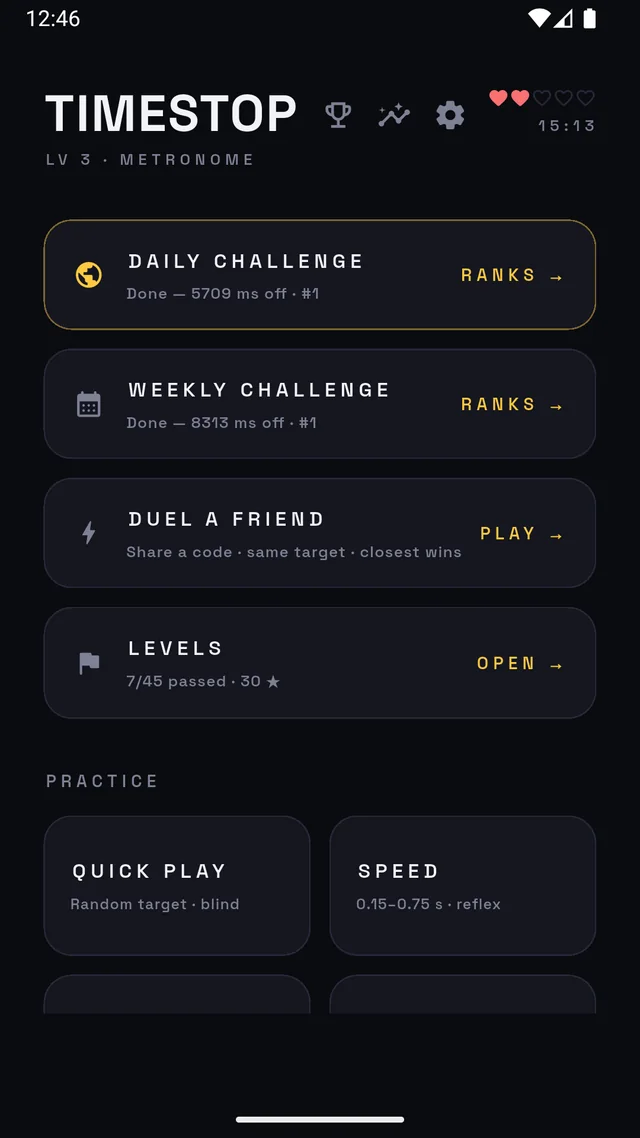
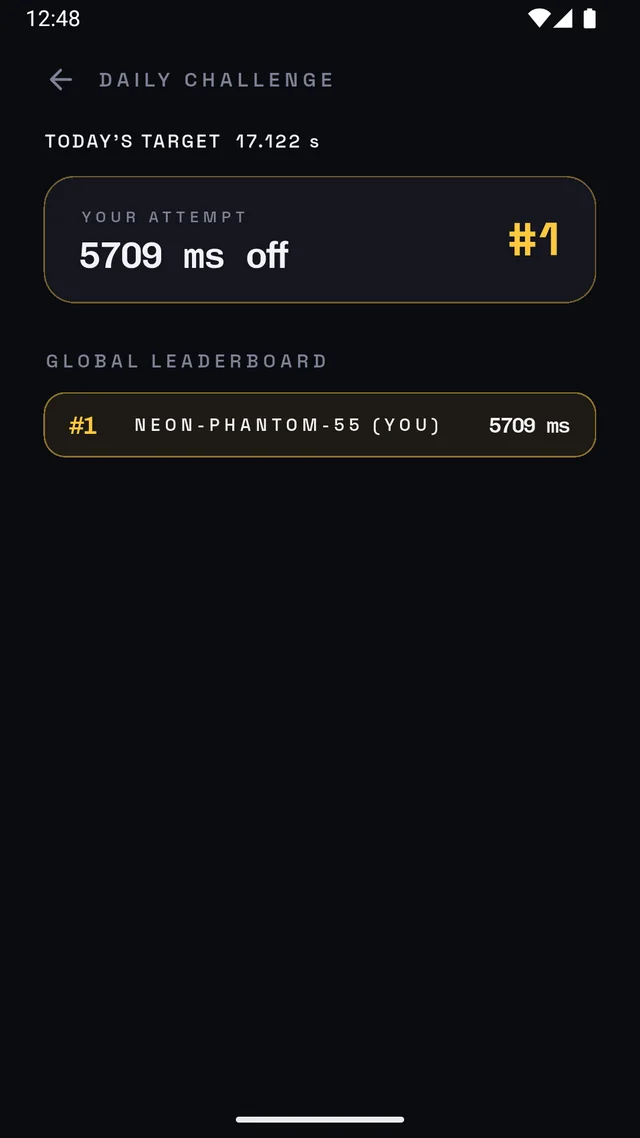
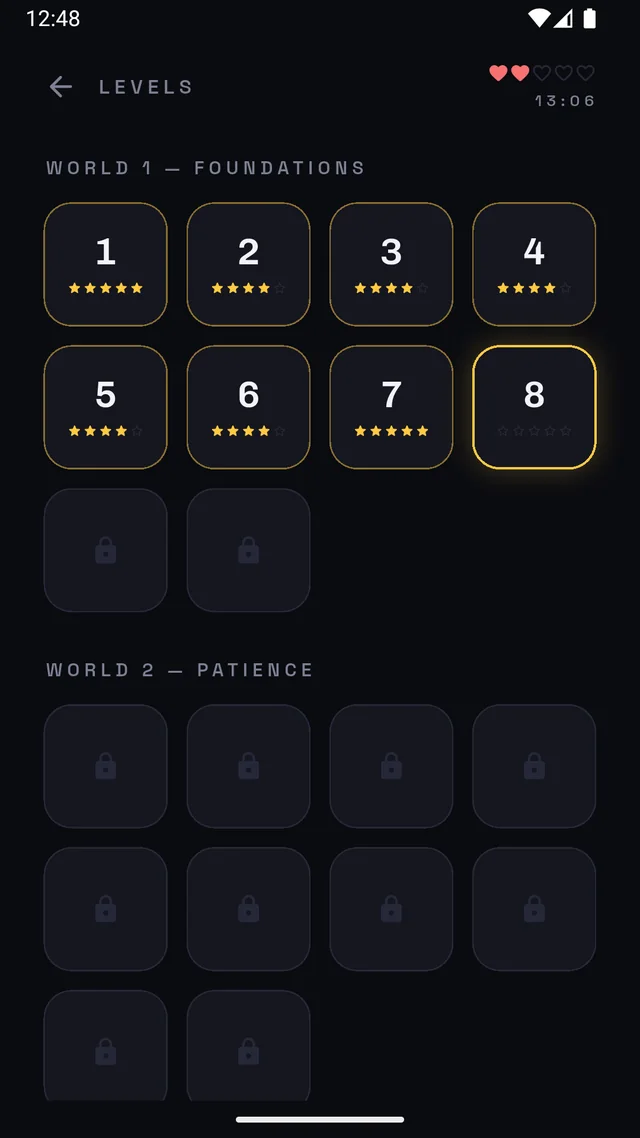
Around that core sits everything a live competitive game needs: global leaderboards that update as the world plays, daily and weekly challenges derived from UTC dates, duel codes that connect two players through a realtime channel, and a progression system that keeps a one-mechanic game interesting for 45 levels.
Product overview
The clock goes dark, you count the seconds in your head, and your stop is scored to the millisecond. No reflexes, no luck — just your internal sense of time, measured honestly.
Everyone in the world gets the same challenge and one shot at it. Global leaderboards make a two-second round worth coming back for every day.
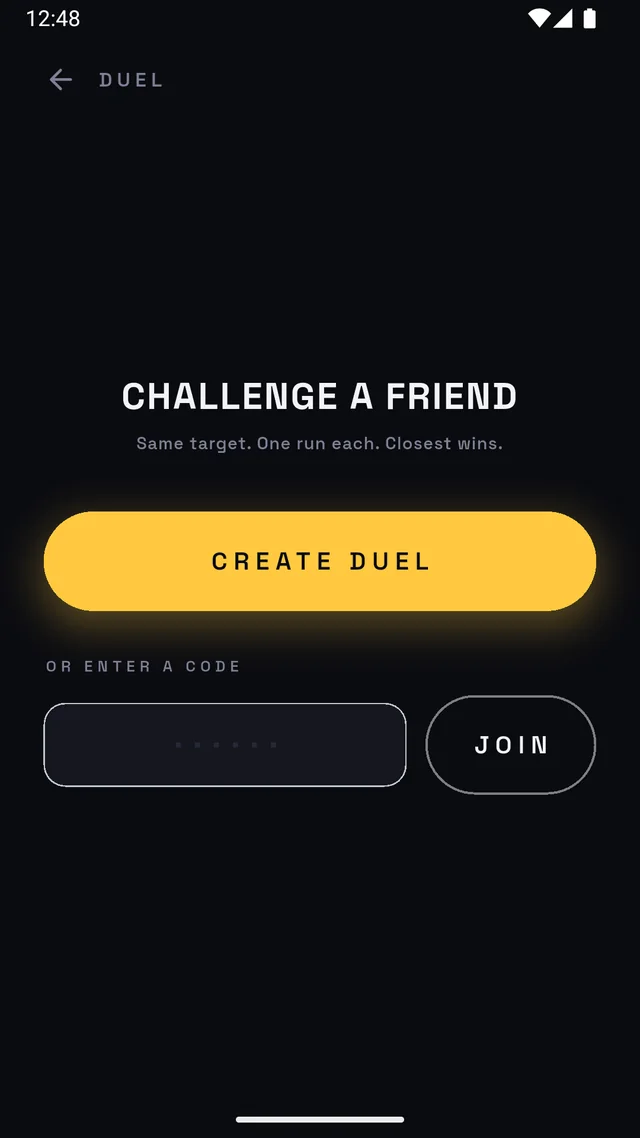
Share a code, receive the same target, and compare results through an ephemeral realtime channel.
A progression arc with star ratings and unlockable themes turns a single mechanic into a game with somewhere to go.
Verified architecture
TimeStop keeps the precision game loop and progression on-device. A monotonic Dart Stopwatch measures rounds, SharedPreferences preserves anonymous state and unsynced attempts, Supabase stores daily and weekly leaderboard entries, and Supabase Realtime provides ephemeral broadcast/presence channels for 1v1 duels.
Technology
Every technology below is tied to the audited project source—not to a company-wide capability list.
Constraints
Solution
Engineering challenges
The controller captures Stopwatch elapsed time before result-state work, then derives the displayed millisecond difference from the measured duration.
Attempts are saved locally before Supabase submission, cached leaderboards render immediately, and failed submissions can retry later.
A generated UUID and display name identify the player while six-character duel channels use Realtime broadcast and presence instead of stored user profiles.
Integrations
Reliability & security
Outcome
TimeStop shipped publicly on Google Play with millisecond-displayed timing, 45 levels across five worlds, daily and weekly challenges, anonymous global leaderboards, realtime 1v1 duels, achievements, progression, ads, and crash reporting.
The repository does not include Supabase migrations or row-level-security policies, so this case study describes the verified client contract without claiming an independently audited backend policy configuration.
Lessons learned
Related Jiss Tech services
What this proves
A shipped game demonstrates things a portfolio mockup can't: precise client-side engineering, Supabase-backed leaderboards and realtime channels, store submission and release management, and the product judgment to keep something simple fun. It's the same end-to-end capability behind our mobile app development work — and the reason clients trust us with apps that face their own customers.
We'll give you an honest read on the smallest version worth shipping — and a fixed price to get it into the store.